News

Learn why dentists may x-ray your teeth

When your dentist examines your mouth, they are looking for changes and potential problems which may need treatment. Regular appointments help to diagnose issues before they become serious. However, there’s a limit to how much can be seen with the naked eye, no matter how thorough the examination.  This is why x-rays are so valuable, they help to see between and inside the teeth where tooth decay (holes) is hidden and commonly occurs.  

Although the enamel on the tooth surface may appear intact, an x-ray can help to pick up signs of decay underneath. X-rays also help to detect problems with the roots of the teeth, changes in the bone, unerupted teeth such as wisdom teeth, infections and if there are issues with the jaw and facial bones.  X-rays also assist with planning for dental care, including fillings, implants, tooth extraction and orthodontics.   

Are dental x-rays safe? 

Absolutely. Modern digital x-rays use very small amounts of radiation to create an image of the teeth and bones of the mouth and are safe for adults and children.  

Radiation is measured in units called ‘Micro-Sieverts’. Walking around each day exposes us natural background radiation of 10 micro-sieverts whilst eating a banana is equivalent to 0.1 micro-sieverts. To put this into perspective, a typical single dental x-rays is equivalent to the natural radiation of eating two bananas.  

If you are pregnant or breastfeeding, let your dentist know before you have any dental examination, including x-rays.  According to health experts, for women who have not had a recent dental check and where there are benefits in having an x-ray, there is no need to defer having one. 1 

When your Dentist look at x-rays, they are looking for subtle changes in how light or dark an area on the x-ray appears to the surrounding area. This tells them if there has been any change in the mineral structure of the teeth and bone. 

What type of dental x-ray would I need? 

The type of x-ray you have will be based on the information your dentist needs.   

  • The most common type is what’s known as ‘Bite wing’ x-rays, which are generally taken at your first visit and then at intervals of between 12-24 months depending on your tooth decay risk factors. 
  • Periapical x-rays help to view the entire tooth, including the roots and surrounding bone.  These types of x-rays are useful for helping to diagnose infections, bone levels, tooth aches or root structures and are required before a tooth is extracted.  
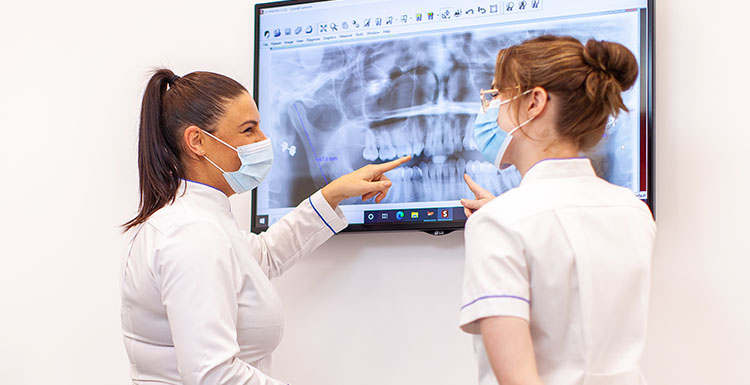
  • Panoramic x-rays, also called a ‘full mouth x-ray’ or OPG, help to visualise the entire mouth, sinuses, bones and jaw and to assess the stages of tooth development in children. They’re also useful to view the wisdom teeth and determine the extent of gum disease. These type of x-rays are typically taken at an initial consultation and every 5 years thereafter. 
  • A lateral cephalometric x-ray which is taken side on, is often done in combination with a full mouth x-ray, and helps to plan orthodontic treatment.  
  • A CBCT or 3D x-rays is taken when your Dentist needs to accurately visualise the structures of the mouth in 3D, for implant planning, orthodontics, or following trauma 

 

How often should I have my teeth x-rayed? 

Your dentist will advise you about the type and frequency of x-rays required. They aim to minimise the number of x-rays they take. Typically, your dentist will take a set of baseline x-rays such as bitewings, periapicals and OPG’s on your initial visit.  

Additional x-rays such as periapicals may be required if you have a toothache, require an extraction or tooth you are having treatment on a tooth such as a crown or root canal treatment. 

If you have any questions about x-rays or other dental related information, speak with your dentist.  Book an appointment today to discuss your own individual needs and ensure good oral health.  

[1] ADA_OHP_FactSheets_Pregnancy_23052017.pdf.aspx

Let us help you decipher dentist lingo


Many of us have had the experience of sitting in the dentist chair and thinking they’re talking another language. This is because dentists and their dental assistant use dental terminology to describe conditions of the teeth and mouth.  This terminology helps to record accurate information and save time. To patients their words can be confusing – until now.   

Read on to understand more about the terminology dentists use and what it all means. And importantly, don’t hesitate to ask your dentist or dental assistant to explain what they’re saying.    

Your mouth is divided into quadrants 

Dentists divide your mouth into four separate regions known as quadrants. The upper part of your mouth forms the first two quadrants and the lower part of your mouth the third and fourth quadrants.  Working clockwise, your top right side is quadrant 1, top left is 2, lower left is 3 and lower right is 4.  Each tooth also has it’s own individual identifying number, for example, tooth #1 is your front tooth, working backwards into the mouth, your next tooth is #2 and this continues up to tooth #8, if you have all of your teeth present in that quadrant. When your dentist is examining your teeth, they will often call out two numbers.  

Why so many teeth? 

You may hear your dentist name your teeth as incisors, canines, premolars and molars, or third molars (wisdom teeth). Each of your teeth serves a special function to bite, grind and soften food so it’s safe to swallow.    

It’s not only numbers which are code for your teeth and where they are located, your dentist will also use number and word combinations to describe what they’re seeing. For example, you may hear them say words like, mesial (closest to the front of the mouth), lateral (side), incisal (cutting side) distal (closer to the back of the mouth) which are commonly used to explain which portion of a tooth they’re examining.   

When a tooth has had previous treatment, there is also a special way of relating what’s been done.  Restorations may be described as being made from composite, resin or amalgam. When a tooth is missing, decayed or filled, your dentist will also describe the condition of any restorations and if they are still in good condition or need replacing.  

Handy dental terms  

  • Bruxism – clenching or grinding your teeth 
  • Root canal therapy – the removal of infection from a tooth 
  • Crown – made of strong dental material such as porcelain or metal to cover the entire tooth -like a crash helmet for a damaged tooth 
  • Occlusal splint – a night guard worn if you’re clenching and grinding 
  • Dental implant – a replacement for a missing tooth root in your jaw bone made from pure titanium . Used to anchor a new crown, bridge or denture 
  • IV sedation – known as ‘twilight or sleep dentistry’  
  • Abscess – acute or chronic infection in the gum or tooth 
  • Bridge – a procedure to replace one or more missing teeth using the teeth either side of the gap to hold it in permanently in place 
  • Calculus – another word for tartar, which is is a hard mineral deposit on the tooth surface  
  • Canine teeth – also known as the eye teeth used for slicing and tearing into food. There are two canines in the upper and lower jaws 
  • Tooth Decay – also known as holes or cavities. This is the result of tooth enamel and dentine becoming soft and infected by bacteria in the mouth 
  • Dentine – the yellowish tissue that makes up most of a tooth, located beneath the enamel which is the white, hard outer layer  
  • Dentures – false teeth made of acrylic or metal; can be complete (replacing all teeth) or partial (filling in spaces left by missing teeth) 
  • Enamel – the white part of the tooth you can see above the gums. It is the hardest substance in the body 
  • Erosion – the loss of tooth enamel due to acid attack 
  • Filling – used to replace lost tooth structure following tooth decay, erosion, fracture or trauma. Commonly made from tooth coloured materials such as composite resin 
  • Fluoride – a natural mineral found in toothpaste and water that strengthens tooth enamel and prevents decay 
  • Gingivitis – an early form of gum disease characterised by inflamed or bleeding gums as a result of plaque bacteria build-up along the gum line 
  • Hygienist – a dental practitioner specialising in the prevention of dental disease and the promotion of good oral health 
  • Incisor – a front tooth used for slicing into food. There are 4 incisors in the upper and lower jaws 
  • Mandible – the lower jaw 
  • Maxilla – the upper jaw 
  • Molar – teeth used for grinding, located on both sides of the jaw. There are up to 6 molars in the upper and lower jaws 
  • Orthodontist – a dental professional who specialises in dental and facial irregularities such as crooked teeth and mismatched bites 
  • Periodontal disease – an advanced gum disease which may occur if gingivitis isn’t treated 
  • Periodontal ligament – tissue that separates the tooth from the bone socket, and anchors the tooth to the bone 
  • Plaque – a soft, sticky substance comprised of bacteria and similar substances that build up on teeth 
  • Premolars – teeth with a flat biting surface, used for tearing and crushing food. There are 4 premolars in the upper and lower jaws 
  • Pulp – the living tissue at the centre of each tooth containing nerves, blood vessels and connective tissue 
  • Scaling – the process of removing harmful substances such as plaque, tartar and stain from teeth 
  • Sealant – a material applied to biting surfaces of newly erupted back teeth to prevent cavities forming 
  • Tartar – when plaque isn’t cleaned away, it can harden into tartar. Dentists will also sometimes call this calculus 
  • Veneer – a thin layer of material made to cover the front surface of a tooth to improve its appearance or position 


Book an appointment with your dentist to put your new knowledge into practice. You may want to ask them how your 13 is looking!   

All you need to know about dentures


Dentures are artificial teeth, used as a solution to fill the gaps when natural teeth are missing. Dentures, also called ‘false’ teeth, come in a range of different types. Generally, there are three categories of dentures: complete, partial or implant-retained.  

As with other dental technology dentures have undergone several innovations, particularly in the last few years.  This has meant improvements in the way dentures look, feel, and sit in the mouth to work more efficiently when eating and talking.  

How do I know if I need dentures? 

There are a number of reasons why it’s important that lost or missing teeth are replaced.   

  • Being able to chew and eat properly.  Teeth fill a primary purpose of softening food so it can be swallowed. When teeth are missing, there are limitations with diet and the textures of food. 
  • As supportive structures around the surrounding teeth and to conserve remaining natural teeth.  
  • Supporting other dentures.   
  • To transfer biting forces onto remaining teeth, rather than the gums.  
  • Appearance – our self-esteem is strongly linked with how we look and smile. 

How to decide which dentures are right for you 

You should be guided by your dentist who knows your history as to what type of dentures would suit you best. You have choices about the way your dentures attach in your mouth and how they will look. 

Types of dentures 

Full or complete dentures – rest on the gums and replace all the missing teeth in the upper or lower jaw. Sometimes people are not able to retain any of their natural teeth, so need a full set of dentures. 

A partial denture – replaces some teeth and uses securing clasps to attach the denture to existing teeth. 

An implant-retained denture is designed to replace one or more teeth and is secured to the jaw through implants. 1 Implants can be particularly useful for lower dentures which tend to sit less firmly on the gums and can tend to move around. 

Denture materials 

Acrylic (plastic) – full or complete dentures are often made from acrylic (artificial base, gums and teeth). Although they provide the best suction and fit when replacing a full set of missing teeth, they are not always best option for partial dentures  

Metal & acrylic metal dentures bases with natural looking acrylic gums and teeth are the ideal option for partial dentures for stability and retention.  

Your dentist will work with you to identify which material is the most suitable for you based on your oral health and unique situation. 


As with natural teeth, dentures need to be cared for and cleaned regularly. Whatever type of denture you have, your dentist will ensure they are fitted and adjusted to your own mouth. It’s important to monitor the way your dentures are working for you so your dentist can recommend changes if they’re needed.  

Book an appointment with your dentist today to discuss your options when it comes to dentures.  

[1] Dentures | healthdirect


Sources

ADPA – Australian Dental Prosthetists Association

Why should I get my cavities treated?


Cavities or holes in teeth are also known as tooth decay or caries. Plaque, a sticky film of bacteria, constantly forms on your teeth. When you eat or drink foods containing sugars, the bacteria in plaque produce acids that attack tooth enamel. The stickiness of the plaque keeps these acids in contact with your teeth and over time, enamel, the hard outer layer of your tooth, can break down exposing the sensitive dentine underneath. Left untreated, holes in teeth continue to grow bigger resulting in moderate or severe toothache and even the eventual loss of the tooth.

Can a cavity fix itself?

Cavities are a progressive condition, so without treatment, they will never get better.  Unlike the rest of your body, your teeth are not protected by your immune system, so they don’t have a natural ability to fight infection. Preventing your teeth from cavities occurring is always the best option.

When a cavity is in its early stages of formation, you might be not be aware that it’s occurring as the enamel outer layer of the tooth doesn’t contain any nerves to alert you to the problem.  Early cavities are usually picked up during regular dental examinations or dental x-rays and are best treated at this stage as treatment options are generally less complex and less expensive.

A cavity left to grow bigger will eventually reach the dentine, the inner sensitive part of the tooth and cause tooth ache which can range from mild to severe, especially in reaction to cold food and drinks. If left for a prolonged length of time, the tooth becomes increasingly fragile, risking fracture of the tooth, and allowing food to become trapped within, which will eventually lead to infection of the nerves at the centre of the tooth. Unfortunately, this can then result in the formation of an abscess causing constant pain or swelling of the face. When decay affects the nerves of the tooth, root canal therapy or tooth extraction become the only effective treatment.

It is important to make an appointment with your dentist if you have any pain from your teeth to avoid the problem escalating and potentially becoming more expensive. Book an appointment with your dentist today and ask them to check your teeth for cavities.

How can I tell if I have a cavity?

In the early stages of a cavity forming, you may not have any symptoms. Generally, toothache or pain when chewing and sensitivity to cold and hot foods and drinks are the early signs of a cavity. Some people experience gum swelling, bad breath or an unpleasant taste in their mouth.  In the early stages of a cavity developing, spots or discolouration can sometimes be seen on the surface of the tooth.

Factors that can increase the likelihood of cavities

Anyone with teeth is at risk of getting cavities. However, some factors can increase the likelihood of cavities forming.  Infrequent or ineffective tooth brushing, not flossing and insufficient fluoride can all increase the risk.  A diet high in sugary or acidic food and drinks is a major component of the risk factors in developing cavities. Hormonal changes such as during pregnancy or menopause which cause a dry mouth, gum recession or other mouth changes are also risk factors.

It’s not always possible to avoid cavities forming, though early detection prevents decay affecting the deeper layers of the teeth and reducing the risk of more complex dental problems. Regular dental check-ups are a perfect opportunity for early detection of cavities.

Children can have cavities

Children are prone to cavities, which left untreated, can affect their development and speech. Children benefit from regular dental check-ups, ideally starting before their second birthday.  Early detection and treatment of cavities can help to retain baby teeth in their correct position, helping their permanent teeth to be correctly aligned. Speak with your child’s dentist about fissure sealants – resin barriers which provide a barrier to the bacteria which cause plaque. Book an appointment today.

What’s involved in filling a cavity?

Filling a cavity is done in a number of steps. Your dentist will examine your mouth and take X-rays to determine the extent of the decay and the area they need to focus on.  You’ll be offered numbing options to help you feel as comfortable as possible. Your dentist will clean and remove the decay from the tooth. A filling material will be placed into the space and then shaped and polished, so it is smooth. The type of material used will depend on the location of the tooth and how much wear and tear it’s exposed to. Your dentist will talk with you about your options.  You’ll be asked to bite down gently to make sure the filling is not too high and to check the level is correct and is not affecting your bite.

What to do with a dental emergency this holiday season


How do I know what a dental emergency is?

Urgent dental care is required in a dental emergency. This is often due to the pain that a person is in or to prevent any worsening of the issue. Such things can include:

  • Severe toothache and pain
  • Cracked or chipped teeth
  • Dental trauma or accidents such as a tooth that has been knocked out
  • Dental infection of either the tooth or gum
  • Placement of a final crown restoration when the temporary crown is lost or causing issues
  • Denture repairs
  • Lost fillings

When should I see the dentist?

Many of our dental centres remain open over the holiday season. Give your local nib Dental centre a call as soon as your dental emergency occurs and ask for an emergency appointment. All our centres ensure that they have emergency appointments available daily for just this reason. The team will also be able to guide you on some simple steps to take to keep you comfortable and prevent further damage until your appointment.


Steps to follow if a tooth has been knocked out

Follow these simple steps and be sure to get in touch with your local nib Dental team.

  1. Find the tooth, if it is clean, gently place it back in the socket ensuring you hold the tooth by the crown and not the root.

If the tooth is dirty, wash it in milk or in the mouth before placing it back in the socket.

  1. If you are unable to place the tooth back in the socket, store it in milk or in plastic wrap, never in water.
  2. Call your local nib Dental team for an emergency appointment as soon as possible.


What will the cost of an emergency dental appointment be?

The cost for your emergency dental appointment will vary depending upon the individual dental treatment you require. Your dentist will discuss any costs that are expected at the time of your appointment.