News

Understanding gum disease: Don’t let these hidden dangers steal your smile

What you need to know about gingivitis and periodontitis

Most of us know how important it is to care well for our teeth. However, it’s just as important to be aware of the structures which surround and support teeth and to look after them to avoid gum disease and tooth loss.   

Gums provide a protective covering for the bones which anchor our teeth in place. And although we can’t see these bones as clearly as our teeth, without their support our teeth don’t have a secure base. This is why gum disease is one of the major causes of tooth loss.

Gum disease

There are two stages of gum disease – gingivitis and periodontitis. Most of us, at some point in our lives, will experience gingivitis. This can be related to times when we may not have been as careful with our oral hygiene, or we’ve been unwell. Smoking and vaping can also affect gum health because of changes to healthy blood flow and an increase in bacterial plaque.

Gum disease has also been linked with a range of health conditions, including diabetes, strokes and cardiovascular disease. Gum health is also influenced by what we eat and some nutrients are particularly important in sustaining tooth and gum health. Calcium, Vitamins D and C as well as protein, all help to nourish the connective tissues in our gums.

Gingivitis

The name for early gum disease is gingivitis. This is caused by a build-up of plaque on the teeth and along the gum line. Plaque contains bacteria which causes the immune system to trigger an inflammatory response. This is why gums become swollen and red when gingivitis is present.

Gingivitis can cause changes to the surface layers of the gums, especially where the gum meets the tooth. 

The gums become swollen, red and can bleed, especially when brushing. As the gums swell and pull away, they no longer work like a firm ‘collar’ around the tooth and small pockets can form where food and bacteria settle.  

When gingivitis is in the early stages, it can be reversed by paying more attention to brushing. Be guided by your dentist in the most effective technique. For many people, the temptation can be to avoid brushing because the gums are tender and may bleed, though these are signs that more brushing is needed, not less. Brushing at least twice each day with a soft toothbrush, using a fluoridated toothpaste and flossing daily helps to remove bacteria and plaque which cause gingivitis. 

Some people also like to use a tongue brush which can help to remove bacteria from the tongue.  

Periodontitis

When gingivitis is left untreated, it can progress to a condition called periodontitis. This means that there is inflammation and infection in the periodontium – the structures and tissues which hold the teeth in place. Spaces can form in between the tooth root and the gum, and these periodontal pockets form the ideal catchment for food and plaque to build up. Over time, these pockets become larger, the periodontium becomes damaged, and bone can be lost. When this happens, the bone can no longer hold the tooth so it becomes loose and may need to be removed.

Unfortunately, once a tooth loses its stable anchor, it’s very difficult to save. Regular dental checks and preventing gum disease in the first place helps to retain teeth throughout the lifespan.   

Our 4 tips to avoid gum disease

There are a few things you can do to care well for your gums, most of them centred around removing the plaque which causes gum disease.

  • Focus on cleaning your whole mouth by brushing your gums as well as your teeth. Pay attention to brushing where your gums and teeth meet and angle the brush at 45°. 
  • Use a soft-headed toothbrush and fluoride toothpaste. Replace your toothbrush regularly and when you’ve recovered after being unwell.
  • Clean between your teeth with floss and/or interdental brushes. This will help to remove food from nearly half the surface area of your teeth where brushing can’t reach. 
  • See your dentist regularly – book an appointment today.  

Improve your oral health routine this year

Improve your oral health routine this year

Many of us see the New Year as an opportunity to make positive changes and to improve our general health and well-being. Although we’re all individuals and entitled to our own personal goals, every one of us benefits from having a healthy mouth and investing a little time and energy into our oral health.

Oral health practices rely on repetition and frequency, in the same way that many health-related routines do. It is this daily attention to our teeth and gums which makes all the difference in reducing the risk of developing problems.

Along with this, regular dental check-ups, every 6-12 months, help to identify early problems before they become more complex, especially as we age. Booking regular check-ups is also a great way to support overall good health and keep us on track throughout the year.

Improve your oral health with our 10 New Year resolutions

  1. Make it easy to care well for your teeth. Arrange your bathroom and vanity so your toothbrush, toothpaste and floss are in plain sight. Stock up on tooth cleaning supplies if you use more than one bathroom. You’re less likely to leave brushing ‘until later’ if everything you need is close.
  2. Brush your teeth at least twice each day with fluoridated toothpaste. Buy yourself a new toothbrush for the New Year and choose one with soft bristles and a small head. Brush your tongue as well, by using either your brush or a tongue scraper.
  3. Floss in between your teeth at least once each day. A great time to do this will be just before you go to bed. Be gentle as you guide the floss between your teeth and avoid ‘snapping’ the floss into place.
  4. Make an appointment to see your dentist every 6 months. Book a check-up and mark it in your calendar. While you’re there, speak with your dentist about your brushing and flossing technique and don’t forget to book your next appointment before you forget.
  5. Make a decision to stop smoking or vaping. Each is damaging to oral and general health and the New Year is a great time to make changes.
  6. Try to cut back on sweet drinks like soft drinks, cordial, energy drinks and juice. These all contain sugar which increases the risk of tooth decay. Drink water instead, preferably fluoridated – check with your local Council.
  7. Review your stress management habits and make positive changes. Many dentists are reporting that they’re seeing increased numbers of patients who are clenching and grinding their teeth because of stress. Custom-made mouthguards help to stop tooth damage from this unconscious habit.
  8. Stop using your teeth as tools, especially if you’re in the habit of opening packets with your teeth or using your teeth to hold something when your hands are full. Each tooth is precious and when one is lost or damaged from an undue force, there’s a flow-on effect on the other teeth.
  9. Create a new habit of always rinsing your mouth with plain water after drinking tea and coffee. This will help to prevent your teeth from becoming stained. Speak with your dentist about teeth whitening options if you’d like a whiter smile.
  10. Make a deal with yourself that you will stick with your new oral health regime. Like other habits, it can take a couple of weeks for new routines to become established.

So, book an appointment and start the New Year off with a plan to look after your mouth as it deserves to be cared for.

Our tips for teeth-healthy festive eating

Teeth-healthy Christmas foods

By the end of the year, we’re all entitled to relax a little and enjoy ourselves. For most of us, many festive celebrations centre around food and drinks, making it easy to lose a sense of control over what we’re consuming. And while no one wants to be a total grinch about the holidays, it can be helpful to enter into the festive season with a goal of moderation when it comes to teeth-healthy foods.

Balancing teeth healthy foods at Christmas

For 365 days a year, the same evidence around oral health applies – that sugar is sugar, no matter what form it’s in. Whether sugar is in a liquid or solid form, warm, cold, frozen or somewhere in-between, all sugar increases the risk of tooth decay. Lollies, desserts, sauces, toppings, juices and soft drinks all contain forms of sugar and no matter how it’s packaged, our body processes sugar in the same way.

Fortunately, there are lots of delicious types of foods which also have protective oral health benefits. Finding the ‘sweet spot’ between balancing festive treats with teeth-healthy foods is worthwhile and helps us to avoid feeling we’re missing out on all the fun.

Gum health

Most of us are aware of the types of foods which aren’t so good for us, and which can lead to tooth decay, but gum health is just as important. Gums provide a barrier against bacteria and food entering into the tissues which surround the teeth. ¹Red, inflamed, bleeding gums are a sign that this protective barrier has broken down and can lead to gingivitis, an early form of gum disease. If left untreated, Gingivitis can progress to more advanced periodontal disease, causing tooth and bone loss. When gums are healthy, they work like a collar, forming a firm seal to keep our teeth in their correct position, so it’s important to have regular check-ups.

5 tips for teeth-healthy festive snacking

Remember, not all treats are naughty and it’s important not to feel you’re missing out. ²Some foods are protective and support our oral health. Crisp fruits and raw vegetables are particularly good at cleaning plaque from teeth and freshening breath.

This festive season, reach for the:

  1. Fruit and vegetable platters rich in fiber and vitamin C – these will provide a range of protective nutrients.
  2. The cheeseboard – cheese helps to neutralize the effects of acidic foods.
  3. Other calcium-rich products – milk or soy-based products help to boost saliva production and remineralise teeth.
  4. Vitamin A and D-rich foods- Oily fish is a powerhouse of vitamin D, which helps to strengthen teeth and bones and prevent gum disease.
  5. Water jug – this will help to keep your saliva at the right consistency to rinse away food particles.

5 tips for a teeth-healthy festive season

Why wait until January 1 to develop new oral health habits as New Year resolutions? Book an appointment for a dental checkup over the festive break.

  • Try to cut back on sugar – evidence continues to prove that many of us are consuming too much of this simple carbohydrate, which as well as affecting our oral health, impacts on our general health.
  • Make time to brush your teeth at least twice each day and floss daily. Brushing and flossing are especially important before going to bed. No matter how tired you are after that party, take an extra five minutes to care for your teeth and gums.
  • Care well for your gums and remember, flossing is as important as toothbrushing.
  • Avoid biting down on hard foods. Candy canes, lollies, pork crackling and ice are particular hazards at Christmas time. Dentists often see a peak in cracked or broken teeth as a result of hard textures.

Book an appointment with your dentist today to discuss your dental health.


References

  1. What Are The Best Foods For Gum Health? | Colgate®
  2. Teeth Healthy Foods List: 9 Best Foods For Your Teeth (orthodonticsaustralia.org.au)

Keeping your teeth safe these holidays

Keeping your teeth safe these holidays


Nobody wants to have a medical emergency, including those of a dental nature. Emergencies tend to happen without planning, and often at the most inconvenient times. Fortunately, all of our centres provide emergency dental care, which helps to minimise trauma, reduce infection risk and improve the chances of saving teeth. Check here to make an appointment for emergency dental care.

What does a dental emergency involve?

A dental emergency generally involves some type of trauma, infection and/or pain, involving the teeth or mouth.  Often, accidents are the cause for a dental emergency, though toothache can also be a reason to see a dentist as soon as possible.

What are some common dental emergencies?

It is often unclear what constitutes a dental emergency, especially when not all dental trauma is obvious. However, it’s always worthwhile to book an appointment as soon as possible after any dental injury.

  • A knocked-out tooth.
  • Trauma to the teeth e.g., being hit in the mouth or falling on the face.
  • Toothache or mouth pain.
  • Gum or facial swelling. An abscess can cause swelling and an unpleasant smell or taste.
  • Teeth with chips, fractures and cracks. These can often cause pain when eating and drinking.
  • Badly bitten lips or cheeks.
  • Pain in the jaw.
  • Denture repairs.

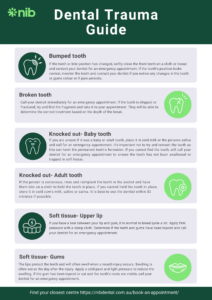
First aid for dental emergencies

It can be helpful to know what to do in the case of a dental emergency. There is often a critical window of time in which a tooth can be saved and to reduce the risk of complications.

  • See a dentist immediately – ideally, within 30 minutes after any dental injury.
  • If a tooth has been knocked out, pick it up by the crown, rinse it with milk, or (very briefly) for 1-2 seconds in tap water. If you don’t have any water or milk with you, gently suck the tooth clean before gently placing it back into its socket.
  • Place the tooth back into its right position in the mouth. Bite down on a tissue or soft cloth to hold it in place. If you can’t do this, take the tooth and any broken portions with you to the dentist.
  • If a tooth has been knocked out, keep it moist by placing it in some milk, never in water. You could also wrap the tooth in clean plastic wrap.
  • Don’t hold the tooth by its roots or wrap it in tissue. The key is to keep it moist.

Dental emergency prevention

It’s not always possible to prevent dental trauma. However, there are a few practices which can help to reduce the risk:

  • Care for your teeth every day. Daily dental hygiene with brushing and flossing helps to maintain oral health and reduce the risk of dental emergencies.
  • Wear a custom fitted mouthguard if you are playing sports. Even during training sessions it’s important to wear your mouthguard.
  • Avoid biting down on hard foods. It’s easy to crack or chip teeth by biting or chewing on hard lollies, tough meat, nut shells and even ice.
  • Never use your teeth as ‘tools’ to open packages or lids. Teeth are not designed to withstand the forces needed to open containers.
  • Avoid chewing on pen lids, toothpicks and other foreign objects. Sugarless gum can satisfy a chewing urge without risking dental trauma.

The effects of Vaping on your teeth and gums

The effects of Vaping on your teeth and gums


Inhaling the vapour of electronic, or ‘e-cigarettes’, is a relatively new practice and research into its effects is still emerging. Much of the popularity around vaping is generated by manufacturers, who claim that vaping is ‘healthier’, ‘more natural’ and less addictive than smoking cigarettes. These messages have influenced many users who believe that given a choice, vaping is less harmful than smoking cigarettes; however, this is not the case.

How does vaping work?

Vaping works by using heat to transform liquid nicotine into vapour, which is then inhaled. Although the ‘smoke’ coming from an e-cigarette can look like a gentle type of steam, it’s really a form of aerosol.

Oral health risks of vaping

Early findings have confirmed that nicotine, even when it’s vaped, restricts blood flow to the gums and throughout the body’s tissues and organs.  In addition, the fluids included in e-cigarettes, which include benzene, formaldehyde, propylene glycol and other chemicals, further increase the risk of developing general health issues, including oral health conditions.

The tissues and structures in the mouth all rely on each other to work effectively. And although the mouth is relatively small in comparison with other body structures, its size is not an indicator of its importance.

How can vaping affect my mouth:

  • Decreased saliva production – making the vaper more prone to developing cavities.
  • Mouth ulcers and bad breath.
  • An increased rate of cavities.
  • Unhealthy, inflamed gums with reduced blood flow.
  • Slower healing after tooth removal, gum and oral surgery.
  • An increased risk of mouth and other cancers.

Is vaping better than smoking?

Although vaping is often marketed as a better or ‘healthier’ alternative, the truth is that vaping nicotine comes with its own health risks, none of which are preferable to those brought on by smoking cigarettes. Dentists are reporting an increase in seeing patients with dry mouth, bad breath, periodontal disease and mouth ulcers, especially in younger generations who are within the highest group of e-cigarette users. These symptoms are all ‘red flags’ for the development of tooth and bone loss.

E-cigarettes also increase the temperature in the mouth, creating a form of stress in the communities of good bacteria so they’re no longer working protectively. This means fundamental changes occurs in the user’s oral microbiome – the range of good bacteria and microbes which live in the mouth.  Another common experience of vapers is a temporary loss of taste, also known as ‘vape tongue’.

What to do if you use a vape

Be aware of your oral health and visit your dentist every 6 months to have your mouth and teeth checked. Meanwhile, chewing sugar free gum can help to stimulate saliva flow and drinking plenty of water will help to avoid having a dry mouth.

Book an appointment today and speak with your dentist about the effects of vaping on your dental health.