
News

nib Dental Care Chastwood has moved


We are excited to announce that nib Dental Care Chatswood centre has relocated to Westfield Chatswood. This change has taken effect from today, Wednesday 5th April, 2023.

Patients will continue to receive the same expert care and service that they’ve come to expect from us, and can continue to book appointments with their existing Dentist. The only thing that’s changed is we’re in a brand new, bigger and better dental centre.

At Westfield Chatswood you will be able to access 4 hours of free parking and take care of all your health, shopping and leisure needs all from one convenient location.

You can find us on Level 2 of Westfield Chatswood, near Coles.

Book an appointment at our new nib Dental Care Centre at Chatswood or call us on 02 9105 8900.
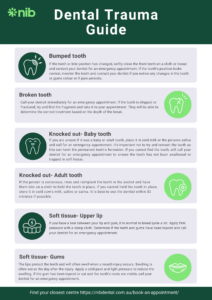
Your Free Dental Trauma Guide

Click to download your Dental Trauma Guide

We understand that accidents and emergencies can often be difficult to navigate, so we’ve created a guide for you and your family to follow when dental emergencies happen. Download and print off your Dental Trauma Guide and keep it in an accessible place for when you need it. You can keep one on your fridge and one in your sports bag for weekends.

Don’t forget, we have emergency appointments available each day.


Dental trauma guide

ADHD and children’s oral health

ADHD and children's oral health


Most of us know attention deficit hyperactivity disorder by its common abbreviation – ADHD. This is a medical condition affecting one in every 20 children. Those that are impacted by ADHD can find dental appointments and day to day care challenging.

Common dental issues for children with ADHD

Children with ADHD can be especially prone to a range of dental issues:

  • Children with ADHD commonly experience anxiety, particularly in situations they don’t understand and can’t control. Dental visits, by their nature, require people to lie back with their mouth open and for a child with ADHD, this can be a particular challenge.
  • An increased risk of cavities. This is because of the difficulties in maintaining regular brushing and flossing routines.[1] Another reason is because of medication leading to changes in diet and appetite. Some medications cause a dry mouth (xerostomia), which also increases the risk of cavities.
  • A higher risk of tooth grinding (bruxism) and dental trauma.
  • A higher risk of diseased, missing, or filled teeth.[2]

Top tips for caring for your child’s teeth if they have ADHD

  1. Develop a regular oral health routine starting from a very young age. It also helps to role model positive oral hygiene habits with your own oral care e.g., brushing twice each day and flossing daily.
  2. Use positive reinforcement and rewards for better results with brushing.
  3. Keep your instructions very simple when teaching your child about oral hygiene. Be prepared to repeat yourself several times.
  4. Focus on the brushing of their teeth, rather than the brushing technique. Some children with ADHD struggle at first with having the brush in their mouth and take time to build tolerance.
  5. Be patient and try a combination of hygiene techniques to work out what’s best for your child.[3]
  6. When booking your child’s appointment, let the receptionist know they have ADHD. Ask if there is a dentist in the practice who is experienced in working with children with this condition.
  7. Schedule appointments for a time when your child is most attentive and least likely to be tired.
  8. Make regular appointments so they become part of your overall health care for your child.
  9. Let the dentist know if there are any changes to your child’s care or management. Medications can cause side effects in the amount of saliva which is produced and it’s important the dentist is aware.

Work in partnership with your child’s dentist

You are the expert when it comes to knowing your child and their dentist is an expert in their oral health. As partners, you can reduce the likelihood of dental problems.

Book your regular appointment with your dentist today to discuss your child’s oral health care.


[1] https://www.adhdsupportaustralia.com.au/adhd-and-dental-care/

[2] https://pubmed.ncbi.nlm.nih.gov/14684974/

[3] https://www.adhdsupportaustralia.com.au/adhd-and-dental-care/

The ultimate guide to Cosmetic Dentistry

The ultimate guide to cosmetic dentistry


Over the last few years cosmetic dentistry has evolved to become more affordable and accessible. So, if you’re like many people and not entirely happy with your smile, it may help to know you have options.

Having a beautiful smile is something which many of us consider important to our overall presentation and confidence. Just like eating a healthy diet and exercising helps us to feel and look our best, how we prioritise our teeth and oral health makes a huge difference to our appearance and general well-being.

You’re probably not alone

You’re likely to find that at least a few of your friends have had some type of dental work done or are considering it, especially those with great teeth. Genetics, environment and good old-fashioned luck play a big role in the type of teeth and smile we have as individuals. Fortunately, we have a range of options when it comes to improving our smile and boosting our confidence.

What is the goal of cosmetic dentistry?

The goal of cosmetic dentistry is to improve the appearance and function of the teeth, gums, bite or smile. It is generally focused on one or a range of treatments including crowns, bridges, veneers, tooth whitening, dental implants and tooth-coloured fillings. And although each treatment is different, the goal of cosmetic dentistry is essentially the same – to create a more natural smile, improving both the look of the teeth and the way they work.

[1] Some cosmetic work is relatively straightforward, for example, tooth whitening, while other treatments are more complex and build on a series of steps that progress toward an end goal such as clear aligners and orthodontics.

What common treatments are considered cosmetic dentistry?

  1. Teeth whitening – lightens the colour of the teeth.
  2. Crowns/bridges – are a fixed solution to missing or damaged teeth.
  3. Dental veneers – are a thin porcelain or resin facing which are attached to the front of the tooth.
  4. Tooth bonding – where a hard resin is applied to damaged parts of the teeth or to fill gaps.
  5. Dental implants – are a replacement root for a tooth that is bonded with the bone in the jaw. A crown is then made to match the surrounding teeth to fill the gap formed by the missing tooth.
  6. Orthodontics – are devices which straighten teeth, so they are aligned. Commonly called ‘braces’, orthodontic appliances can be attached to the front or back of the teeth, or made from clear plastic trays known as clear aligners.

Look after the basics first

If you’re considering having dental cosmetic work done, book an appointment with your dentist. They can examine your mouth and provide you with options to improve your smile. Brushing twice each day, flossing daily and caring for your teeth and gums are dental care basics. Often, the success of any cosmetic treatment relies on good oral health foundations. Speak with your dentist about what’s right for you and start getting excited about having a brilliant smile!

Book an appointment with your dentist today to discuss your options for cosmetic or any other dental care.


[1] https://www.ada.org.au/Careers/Dental-Team/Technician 

The Truth Behind Viral DIY Dental Hacks, According to Dentists


Many of us are keen to learn more, and social media has endless information to help us in our day-to-day lives. Social media has become saturated with recommendations around ‘at-home hacks’, and DIY dental. 


Understanding the risks of DIY Dentistry

The idea of saving time and money by trying dental treatments at home is understandably appealing. However, what often starts with good intentions can sometimes lead to unexpected problems that often become very costly to fix¹. Many dental professionals have noticed a rise in patients seeking help after DIY treatments have caused damage to their teeth or gums². Tooth and bone loss, gum trauma and issues with tooth alignment are becoming commonly seen outcomes. 


Why Professional Dental Care Still Matters

It’s easy to find videos demonstrating how to whiten teeth, create homemade braces, or reshape teeth using items found around the house—things like rubber bands, nail files, or even Magic Erasers. These videos are popular because they offer simple, low-cost solutions. However, dental procedures are more complex than they might seem, and professional care from your dentist ensures both safety and effectiveness.


Trending social media dental hacks that we should be cautious about

  • DIY braces using rubber bands: Straightening teeth is about more than appearance. Fixing alignment issues with teeth is a complex process as it doesn’t just impact how your teeth look but can also impact how you eat and even breath. Orthodontists complete several years of additional training to safely correct alignment. 
  • Teeth reshaping with a nail file – reshaping teeth at home can lead to cracked, broken and damaged teeth. It also removes the tooth enamel which protects teeth from decay. 
  • Whitening with hydrogen peroxide or charcoal: High concentrations of whitening agents can damage gum tissue and cause lasting sensitivity. Your dentist will ensure your whitening kit is appropriate for your individual teeth and gums. 
  • Using Magic Erasers for stains: These products are abrasive and can strip away enamel, exposing the yellow dentine underneath. 


5 Important Dental Facts to Remember

  1. If it sounds too good to be true, it probably is. Be cautious of advice from individuals who aren’t qualified dental professionals.
  2. Every mouth is different. What works for one person may not be safe or effective for another.
  3. DIY treatments can worsen underlying issues. Without a proper diagnosis, it’s easy to miss signs of deeper dental problems.
  4. Enamel does not grow back. Once it’s damaged, you may face long-term issues like sensitivity and decay. Pain, sensitivity and greater likelihood of decay are common outcomes of tooth filing and scratching off enamel.
  5. Dentists undergo extensive training. In Australia, becoming a dentist requires five years of full-time study, ensuring the highest standard of care and clinical patient outcomes.


Book an appointment with your dentist if you are keen to learn more from an expert and avoid unwanted damage to your smile.  


¹https://www.abc.net.au/listen/programs/lifematters/whats-behind-the-worrying-trend-of-diy-dentistry/13991068 

²https://www.theaustralian.com.au/nation/dentists-fixing-more-botched-diy-dentistry-procedures/news-story/240ae6caa6d12b4ce7219326e761bbb3